
How Do Frozen Embryos, Eggs and Sperm Stay Frozen During Transport?
How do frozen embryos, eggs and sperm stay frozen while travelling between fertility clinics? We explain the science behind dry shippers, liquid nitrogen and temperature monitoring.
If you have frozen embryos, eggs or sperm stored at a fertility clinic, you probably know that they are kept in liquid nitrogen at extremely low temperatures.
But what happens when they need to be moved to another clinic?
You might imagine a refrigerated vehicle or a container filled with ice. In fact, transporting frozen reproductive material involves something rather more specialised.
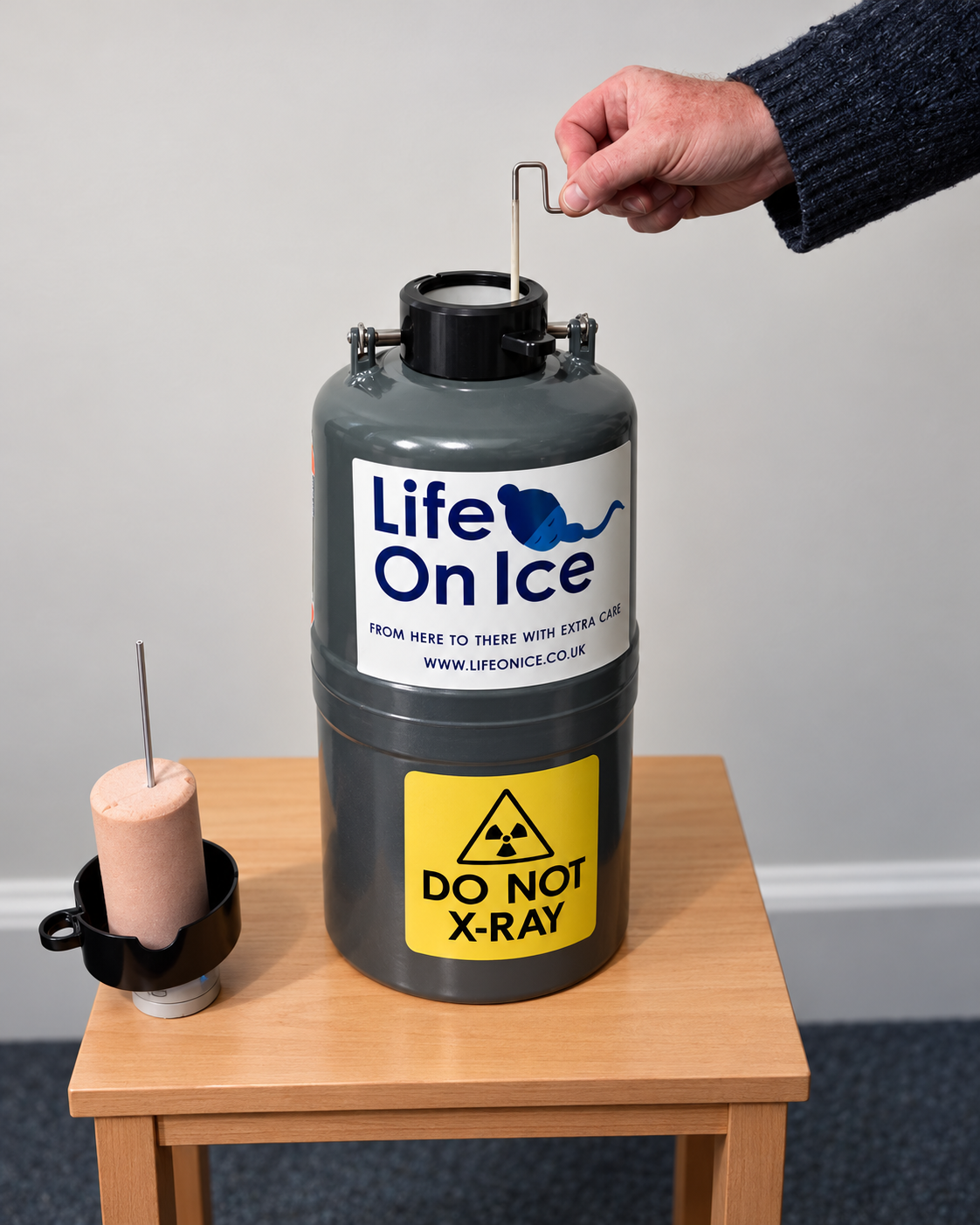
The equipment we use is called a dry shipper, sometimes known as a cryoshipper.
Despite its name, it uses liquid nitrogen to keep everything cold. So why is it called a dry shipper?
What is a dry shipper?
A dry shipper is a specially designed, insulated container that maintains extremely low temperatures for an extended period.
Before a journey, the shipper is prepared using liquid nitrogen, which has a boiling point of approximately -196°C.
Inside the shipper is a special absorbent material that retains the liquid nitrogen. Once the shipper has been properly prepared, there should be no free-flowing liquid nitrogen inside.
Instead, the samples are kept cold by the nitrogen vapour.
This is why we call it a dry shipper.
The design allows frozen biological material to be transported at cryogenic temperatures without the risks associated with carrying a container of free liquid nitrogen.
If you are specifically shipping frozen embryos between fertility clinics, we have explained the wider process in a separate guide.
Why does the temperature matter?
Embryos, eggs and sperm are cryopreserved by fertility laboratories using carefully controlled procedures.
At cryogenic temperatures, biological activity is effectively suspended, allowing the material to remain in storage until it is needed for treatment.
However, maintaining appropriate temperatures during transport is essential.
If frozen reproductive material warms too much, its quality may be compromised. This is particularly important for eggs and embryos, which are usually frozen using a technique called vitrification.
Vitrification involves cooling cells so rapidly that they enter a glass-like state rather than forming damaging ice crystals.
The aim during transport is to maintain the cryopreserved material at sufficiently low temperatures to avoid compromising that state.
The 2026 European Society of Human Reproduction and Embryology recommendations specify that dry shippers should be validated to maintain temperatures below -150°C for the maximum anticipated transport time.
They also recommend temperature monitoring during transport.
How long can a dry shipper keep samples frozen?
Longer than you might expect!
Depending on its design, capacity and condition, a properly prepared dry shipper can maintain cryogenic temperatures for days or even weeks.
But this is not something that should simply be assumed.
Different models have different holding times, and the manufacturer's specifications are only part of the picture.
A shipper needs to be suitable for its intended journey, with sufficient holding time to accommodate the planned transport and foreseeable delays.
This is where validation becomes important.
Validation is simply the process of demonstrating that equipment actually performs as intended.
For a dry shipper, this involves establishing that it can maintain the required temperature for the necessary period.
It is one thing for a manufacturer to say that a container should remain cold for two weeks. It is another to have evidence that the equipment being used is capable of doing so.
How do we know the samples are staying cold?
At Life on Ice, we use temperature monitoring equipment during transport.
A temperature probe measures the temperature inside the shipper, while a data logger records measurements throughout the journey.
This provides a record of the temperature conditions during transport rather than relying solely on the expected performance of the container.
The shipper is also checked before collection, and the receiving laboratory checks the temperature when the samples arrive.
Temperature monitoring is an important part of the process, but it is not the only consideration.
The shipper must also be handled correctly, remain secure and be protected from unnecessary disturbance throughout its journey.
Why do we hand-carry our shipments?
There is more to transporting frozen embryos, eggs and sperm than maintaining a low temperature.
The samples must also arrive at the correct destination, with their identity and chain of custody properly documented.
At Life on Ice, every shipment is accompanied by a trained courier.
We don't simply hand the shipper over to a general parcel delivery company.
Our couriers take responsibility for the physical journey, from collection at the sending clinic through to delivery at the receiving laboratory.
We also provide updates during transport, so patients know how their journey is progressing.
The clinics remain responsible for the clinical aspects of the transfer, including sample identification, consent, release and acceptance. The exact documentation required will depend on the clinics involved and, for international journeys, the relevant regulatory requirements.
For journeys involving more than one country, our guide to international IVF sample transport explains the additional clinic and regulatory arrangements.
If the sample being moved is sperm, our guide to shipping sperm internationally covers that process in more detail.
Our job is to make sure that the transport itself is carefully managed.
What happens when the samples arrive?
At the receiving clinic, the shipper is handed over to the laboratory staff.
The laboratory checks the accompanying documentation, confirms receipt and transfers the samples into its own cryogenic storage system according to its procedures.
The samples remain frozen throughout this process.
They will only be warmed or thawed when the receiving clinic is ready to use them for treatment.
A little science behind every journey
When patients contact us about moving their embryos, eggs or sperm, they understandably want reassurance that their samples will be looked after.
Behind every journey is specialist equipment, temperature monitoring, careful planning and communication between the laboratories involved.
It is a combination of science and logistics, with a very human reason for getting everything right.
And that is what we do at Life on Ice.
Need to move frozen embryos, eggs or sperm between fertility clinics?
Whether your journey is within the UK or overseas, we can help you arrange specialist cryogenic transport.
Contact us with the names of your sending and receiving clinics, and we'll explain the process, provide a quotation and help coordinate the arrangements.
From here to there, with extra care.